
PCV — Pressure Controlled Ventilation
Ventilation is completely controlled by the device. A set inspiratory pressure is held constant for the set time each cycle; delivered tidal volume follows the patient’s compliance and resistance.
Waveforms
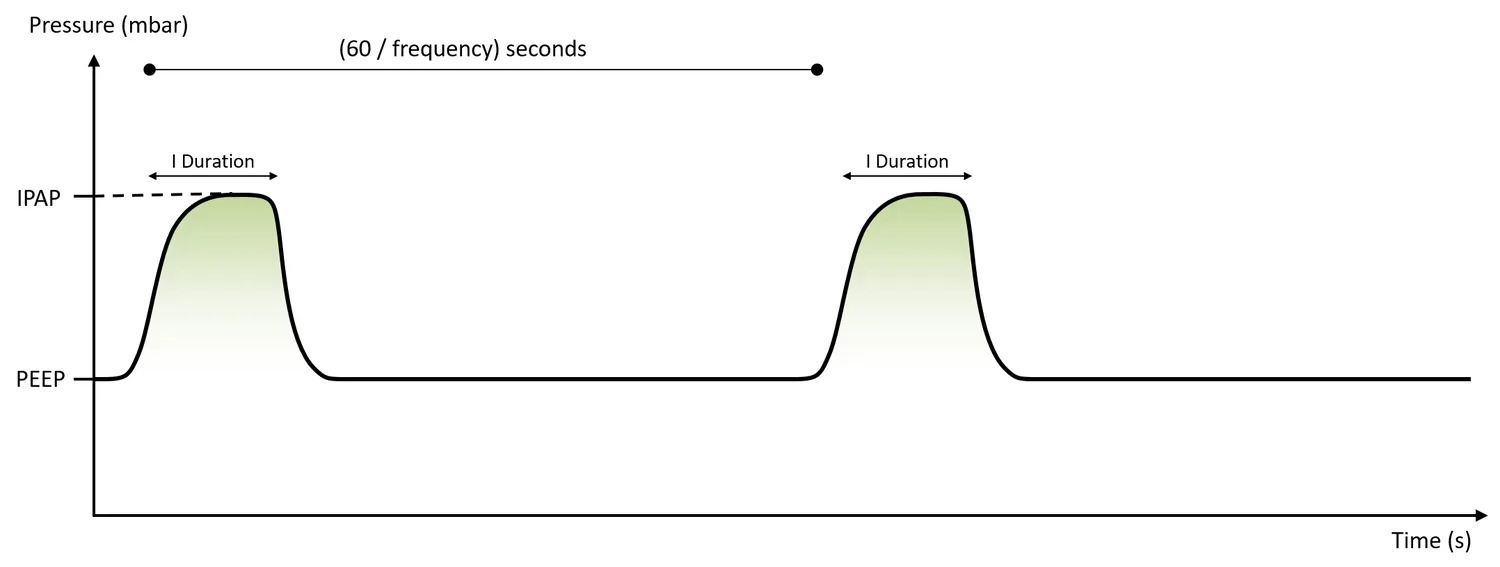
Physiological basis
In PCV the device rapidly reaches the set inspiratory pressure and holds it steadily through the inspiratory time. This “square” pressure waveform allows a high initial flow for early alveolar opening, after which flow decays exponentially (a decelerating flow pattern).
That decelerating profile is one of the main pneumatic advantages of PCV over VCV: gas distributes more homogeneously between lung regions, and compartments with different time constants can reach pressure within the inspiratory time, improving ventilation–perfusion matching.
Because pressure is the controlled variable, tidal volume varies: Vt = ΔP × Crs (ΔP = IPAP − PEEP). When compliance falls or resistance rises, less volume is delivered at the same pressure — so continuous monitoring of tidal volume and minute ventilation is mandatory.
Adjustable parameters 7
Target inspiratory pressure. Indirectly determines tidal volume magnitude.
End-expiratory pressure; affects alveolar collapse and oxygenation.
Monitoring reference; actual delivered volume varies with compliance.
Affects minute ventilation and CO₂ removal.
Determines the I:E ratio; a longer inspiration raises mean airway pressure.
Rate of pressure rise; affects patient comfort and inspiratory synchronization.
1.5× IPAP every 20 breaths; a periodic deep breath that helps prevent atelectasis.